
How to Reply to a GST Notice Online: The Complete 2026 Guide
Every GST notice type with its reply form and time limit, the exact steps to file on the portal, and the checks to run first. From the GST litigation team at DSRV India, Gurgaon.

Every GST notice type with its reply form and time limit, the exact steps to file on the portal, and the checks to run first. From the GST litigation team at DSRV India, Gurgaon.
A reply to a GST notice is not paperwork. It is your first pleading.
Whatever happens next, the adjudication order, the first appeal, the Tribunal, even a writ before a High Court, will be built on what you said in that reply and what you forgot to say. Grounds you do not raise are often treated as given up. Admissions you make casually are almost impossible to take back later.
The good news is that most GST notices are ordinary. A mismatch between GSTR-1 and GSTR-3B. An ITC difference against GSTR-2B. A late return. They do not mean you have done something wrong, and they are usually fixable.
This is the practical companion to our detailed litigation checklist. It covers every common notice type with its form and time limit, and the exact steps to file your reply on the GST portal. If you are holding a show cause notice specifically, work through the 15-point checklist our litigation team follows before replying to a GST show cause notice alongside this guide.
Must Read: Types of GST Notices Explained
A GST notice is a formal communication from the tax authorities telling you they have spotted a discrepancy, or that they need something from you. Depending on what triggered it, you may see it called a show cause notice (SCN), a scrutiny notice, or a demand notice.
Every notice is served through the GST portal, and most are also sent by email and SMS. This matters, because the clock starts from the date the notice is communicated to you.
Common triggers include a mismatch between GSTR-1 and GSTR-3B, ITC claimed in GSTR-3B that does not match GSTR-2B, six months of unfiled returns, e-way bill data that does not line up with your GSTR-1, export figures that differ from ICEGATE, a refund the department believes was wrongly sanctioned, or simply a request for records before an audit.
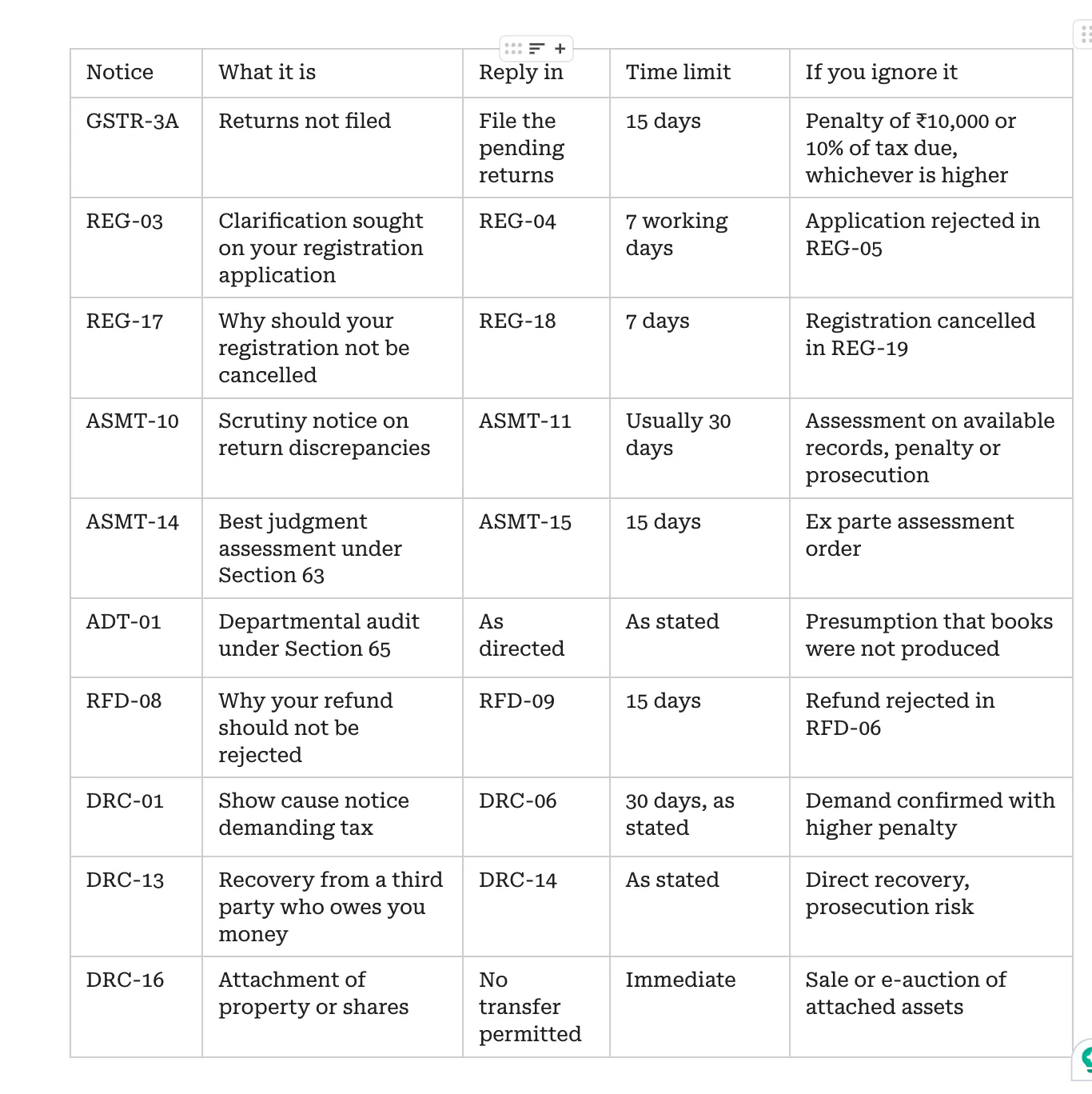
Before you draft anything, identify exactly what you are holding. The reply form and the deadline both depend on it.
Also Read: How to Deal with GST Show Cause Notices (SCNs)
Most taxpayers jump straight to explaining themselves. That is a mistake. Run these checks first, because a defect in the notice itself is worth more than any explanation you can offer. Each one is expanded in our full 15-point show cause notice checklist.
1. Verify the notice and its DIN. Open it on the portal and confirm the Document Identification Number. The Supreme Court in Pradeep Goyal v. Union of India directed implementation of DIN, and a communication without one, where it is mandated, is invalid.
2. Test the officer's jurisdiction. Is your business assigned to the Centre or the State? Does the demand fall inside that officer's monetary limits? Has the other administration already started proceedings on the same subject matter, which Section 6(2)(b) bars? A notice from the wrong officer is a threshold defect worth raising first.
3. Compute limitation year by year. Work backwards from the annual return due date for each financial year and check the mandatory gap between notice and order. For FY 2017-18 to 2019-20, expressly reserve your objection to the Section 168A extension notifications. The issue is before the Supreme Court and preserving it costs you nothing.
Recommended: GST Limitation Period: Notices, Appeals and Deadlines
4. Check the charging section. A fraud-type allegation parked under Section 73, or a fully disclosed interpretational issue dressed up as Section 74 suppression, is a mismatch that can defeat the notice on its own. For periods from FY 2024-25 onwards, both sections have been replaced by the unified Section 74A, so confirm the department has used the right provision for the right year.
Must Read: Section 73 vs Section 74: Defeating 'Suppression' Allegations
Also Read: Section 74A CGST Act: What Merging Sections 73 and 74 Means
5. Record how you were served. If the notice only appeared under the portal's "Additional Notices and Orders" tab with no email or post, note it. Effective service is a live ground, and courts have remanded ex parte orders on exactly this point.
6. Look for vagueness and pre-determination. A notice must state the allegation, the material relied on and the quantification. A bare DRC-01 summary, or a notice written as a conclusion ("you have evaded tax"), falls foul of the Supreme Court's Oryx Fisheries standard and the GST-era line of cases beginning with NKAS Services.
7. Demand the relied-upon documents. Every statement, report, analytics output and third-party record the department relies on must be supplied to you. Where the case rests on someone else's statement, ask for cross-examination. Denying it vitiates the order, as the Supreme Court held in Andaman Timber.
Recommended: Natural Justice in GST Adjudication: Defending Your Rights
8. Test every ingredient of fraud. Suppression needs a deliberate, positive act with intent to evade. Full disclosure in GSTR-1 and GSTR-3B, matching e-way bills and clean banking trails are the strongest antidotes available.
9. Rework the arithmetic. Data-driven notices are full of errors: the same amount counted across two years, gross figures used instead of net, ITC that was already reversed, tax already paid, and CGST/SGST amounts treated as IGST shortfalls. A payment under the wrong head is not non-payment, and the law provides a refund-and-repay route without interest.
Also Read: Understanding and Resolving Inflated GST Tax Demands
10. Structure it like an appeal. Preliminary objections expressly without prejudice to merits, then facts with a document map, then issue-wise legal submissions, then without-prejudice quantification, then reliefs including an express request for a personal hearing, then indexed annexures. File in Form DRC-06 within time. We set out the full drafting structure, with the payment and penalty windows to model before you file, in our guide to replying to a GST show cause notice.
11. Anchor every assertion to a document. Invoices, e-way bills, lorry receipts, stock registers, bank trails and reconciliations. In ITC-denial cases built on a supplier's default, set out your Section 16(2) compliance chain and rely on the bona fide purchaser line of cases.
12. Use the department's own circulars. Beneficial CBIC circulars bind the department under Section 168, and they frequently answer the demand outright.
13. Model your payment windows before the reply date. Paying clearly indefensible items through DRC-03, under protest where rights must be preserved, can bring penalty down to nil, 15% or 25% and narrows the dispute. But an unqualified payment can be read as an admission, so always record the protest.
14. Get the interest right. Interest applies only on the cash component of a delayed payment. Interest on wrongly availed ITC applies only where the credit was actually utilised, and reversal before utilisation is a complete answer.
15. Always seek, and attend, the personal hearing. Section 75(4) makes a hearing mandatory before any adverse order. Carry a hearing note and tender written submissions. Afterwards, test the final order against the notice: new grounds or higher amounts appearing for the first time in the order are bad in law under Section 75(7).
Must Read: GST Adjudication: Time Limits, Process and How to Handle It
Keep a screenshot of the submitted acknowledgement. If the portal misbehaves later, that screenshot is your evidence.
Draft every reply as though the Tribunal will read it, because one day it might. The reply is where jurisdictional objections are preserved, where the evidentiary record is built, and where the penalty outcome is largely decided. It deserves the same rigour as an appeal memo, at a fraction of the eventual cost. If the notice in front of you is a show cause notice, do not stop here: read the complete 15-point checklist before you draft.
And if the order still goes against you, know your next move and your deadline before you need it.
Recommended: GST Appeal Procedure: Filing with Form GST APL-01
Also Read: How to Handle GST Litigation in India
DSRV and Co LLP prepares appellate-quality replies to GST notices, whether scrutiny, audit, demand or penalty, and represents clients through adjudication, first appeal and the GSTAT. As one of the established chartered accountant firms in Gurgaon, we have spent more than 30 years on exactly this work.
Share your notice with us early. The best defences are built before the reply, not after the order.
Clear, practical answers on notice timelines, replies, documents, penalties, and what to do next.
It depends on the notice. REG-03 gives 7 working days, GSTR-3A and RFD-08 give 15 days, ASMT-10 usually gives 30 days, and DRC-01 states its own date. Always work from the date printed on the notice.
The officer can proceed on the records available and pass an order against you. It is still worth filing a late reply with an explanation, and attending the personal hearing, before the order is passed.
For a simple mismatch, yes. For anything alleging suppression, denying ITC or running into lakhs, get professional help. The reply becomes the foundation of every later stage.
Yes, before any adverse order. Section 75(4) requires it, and High Courts have repeatedly set aside orders passed without one.
Raise it. Where DIN is mandated, a communication issued without one is invalid, following the Supreme Court's direction in Pradeep Goyal.
Send us the notice before you draft anything. We will tell you which grounds must be preserved, what the department has got wrong, and what the realistic outcome looks like. Talk to the GST litigation team at DSRV India.

What triggers a transfer pricing dispute in India, the four stages it passes through, and where to go next depending on the stage you are at right now.

How NRIs are taxed in India: residential status, the 120-day rule, what income is taxable, DTAA relief, NRE and NRO accounts, property sales and return filing.

Which professionals can advise on a GST demand order in DRC-07 and file the appeal, what the pre-deposit requires, and how to choose before the clock runs out.
