
TPO Adjustment Received: DRP Route or CIT(A)?
A draft order with a transfer pricing adjustment gives you 30 days and one irreversible decision. Here is how the DRP and CIT(A) routes actually compare, and which one we recommend.

A draft order with a transfer pricing adjustment gives you 30 days and one irreversible decision. Here is how the DRP and CIT(A) routes actually compare, and which one we recommend.
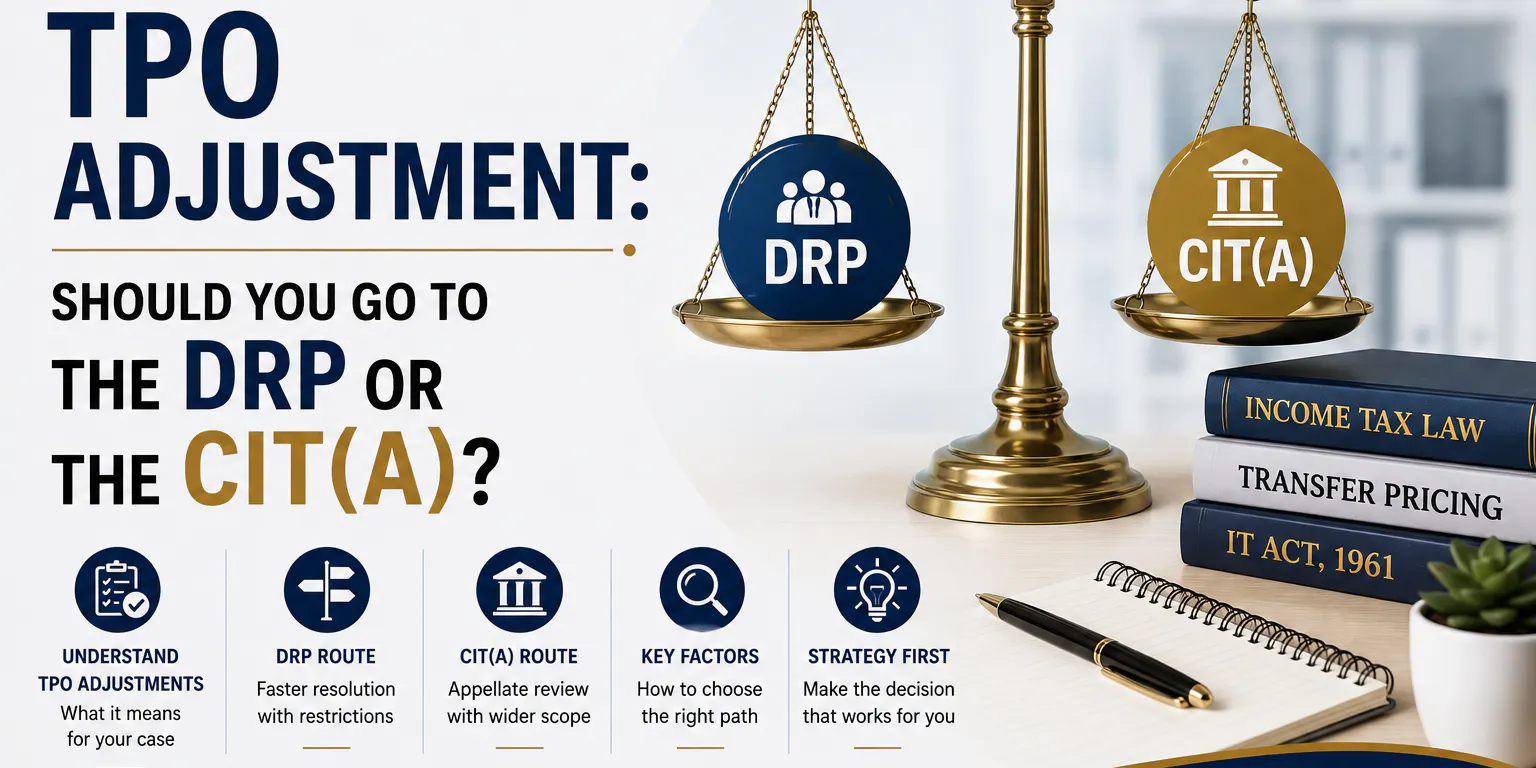
The Transfer Pricing Officer has rejected your benchmarking, treated your management fee as nil or pushed your service margin up, and the adjustment has landed in a draft assessment order.
You now have thirty days and one decision. Object to the Dispute Resolution Panel, or say nothing, let the final order come, and appeal to the Commissioner (Appeals).
The choice is irreversible and it sets the entire path of the dispute, including which forum hears you next, how soon you have to find cash, and how long the whole thing runs. Most companies make it under time pressure with half the picture.
This page lays out both routes honestly and ends with a recommendation.
Where a variation arises from a TPO order, or where the assessee is a foreign company, the Assessing Officer cannot pass a final order straight away. He must first issue a draft order. This special two-stage assessment now sits in Section 275 of the Income-tax Act, 2025, carrying forward the old Section 144C with effect from 1 April 2026.
That draft order is not a demand. Nothing is payable on it. What it does is start a thirty-day clock in which you must either file acceptance, or file objections with both the DRP and the Assessing Officer.
Miss the thirty days and the choice is made for you. The AO completes the assessment on the draft, a demand crystallises, and CIT(A) becomes your only route.
If the AO skipped the draft order entirely and went straight to a final order, that is a jurisdictional defect worth raising immediately, and it is a separate conversation about whether to file an appeal or a writ.
You file objections within thirty days. The DRP is a collegium of three senior commissioners. It can make its own enquiries, it can consider material you did not put before the TPO, and its directions are binding on the Assessing Officer.
The statutory clock is tight by Indian tax standards. The DRP must issue directions within nine months from the end of the month in which the draft order was forwarded. The AO must then pass the final order within one month from the end of the month in which he receives those directions.
From there, your appeal lies directly to the ITAT. You skip the CIT(A) entirely.
Two practical points that matter more than the procedure.
First, no demand exists during those nine months. Nothing to pay, nothing to fund, no 20% for a stay, no recovery risk. On a large adjustment that is real money left in the business for the better part of a year.
Second, the panel understands transfer pricing. Comparables, filters, economic adjustments and DEMPE analysis are its daily work. That is not always true of a general appellate forum.
Courts also police the binding nature of DRP directions. The Delhi High Court held in 2026 that an Assessing Officer cannot make additions contrary to what the DRP directed. If your directions are favourable and the AO departs from them, you have a clean remedy.
For how the panel actually functions, see our detailed guide to the Dispute Resolution Panel in income tax.
You accept, or simply let the thirty days lapse. The AO completes the assessment on the draft within one month from the end of the relevant month, and a demand is raised.
Now you appeal to the Commissioner (Appeals), under Section 357 of the Income-tax Act, 2025 in Form 99, within thirty days of service. From there the next stop is the ITAT.
Understand what this route actually costs you. The demand is live from day one. If you want recovery held back, the working norm is paying 20% of the disputed demand and applying for a stay. And you join a queue: pendency at the first appellate level stood at around 5.4 lakh appeals in mid-2026, which the Finance Minister described bluntly as not good enough.
So the ordinary CIT(A) route is slower, and it asks for cash much earlier.
Trigger
DRP: Objections within 30 days of draft order
CIT(A): No objection filed, final order issued
Forum
DRP: Three senior commissioners with TP expertise
CIT(A): Commissioner (Appeals), faceless
Statutory timeline
DRP: Directions within 9 months, final order within 1 further month
CIT(A): No fixed disposal timeline
Demand during the process
DRP: None until the final order
CIT(A): Live from the final order
Cash required
DRP: Nil during the nine months
CIT(A): Typically 20% for a stay
Fresh material
DRP: Panel may consider it and make its own enquiries
CIT(A): Additional evidence subject to the usual rules
Next forum
DRP: Directly to the ITAT
CIT(A): ITAT, after CIT(A)
Reversible
DRP: No
CIT(A): No
For a transfer pricing adjustment, the DRP is the default. Take it unless a specific reason points the other way.
Three reasons carry the decision. No demand crystallises for nine months, which is the single largest commercial difference. The panel has genuine technical competence in transfer pricing. And a hard statutory timeline beats an open-ended queue.
Choose CIT(A) instead in these situations.
Be realistic about the DRP too. It is a panel of revenue officers, and it does not overturn the TPO in every case. What it reliably gives you is speed, technical understanding, binding directions and nine months without a demand. That is a strong package, not a guaranteed win.
Neither forum can rescue weak documentation. The objections or grounds you file are only as strong as the benchmarking behind them, which is why the work done before the assessment matters more than the forum you choose. A properly maintained transfer pricing defence file is what turns an argument into evidence, and most adjustments that get deleted are deleted on documents, not advocacy.
If you are seeing the same adjustment repeat year after year, the forum question is the wrong one. Look at safe harbour or an advance pricing agreement and buy certainty forward rather than litigating the same point annually. The wider picture is set out in our overview of transfer pricing litigation in India.
Both roads end at the Tribunal, which is the last authority that will examine facts. Everything factual has to be established below or before it, because the High Court hears only substantial questions of law. If you reach that stage, our guide on filing an ITAT appeal covers the mechanics.
DSRV and Co LLP advises on the DRP versus CIT(A) election within the thirty-day window, drafts objections and paper books, appears before the panel, and takes matters through to the Tribunal where required. As one of the established chartered accountant firms in Gurgaon, we have spent more than 30 years on transfer pricing and tax controversy work.
Send us the draft order as soon as it arrives. The decision is better made in week one than week four.
No. The election is made when you file objections or let the thirty days lapse, and it cannot be reversed.
No. No demand exists until the final order is passed pursuant to DRP directions.
Yes, by statute. Directions must issue within nine months from the end of the month the draft order was forwarded, and the final order within one further month. CIT(A) has no equivalent deadline.
He cannot. Directions are binding, and the Delhi High Court confirmed in 2026 that additions contrary to binding DRP directions do not stand.
The thirty-day period is strict. Once it expires the assessment proceeds on the draft, and your remedy is an appeal to the CIT(A).
It replaces the CIT(A) stage rather than removing a level. After DRP directions and the final order, you appeal to the ITAT.
Send us the draft order and the TPO order. We will tell you which route fits, what the adjustment is realistically worth fighting, and what it will cost either way. Book a free 15-minute draft order review with DSRV India.

GST litigation in Gurgaon: what to do while your GSTAT appeal is pending, how to protect your bank account, handle hearings and plan for the High Court.

Facing a transfer pricing dispute or withholding tax scrutiny on cross-border payments? See the defence options at each stage, from TPO to DRP, ITAT and MAP.

Got a Section 148 or 148A notice? Learn when reassessment can be stopped, how to reply, when to go to the High Court and what to do in the first 7 days.
