
How Long an ITAT Appeal Really Takes, and What It Costs
Honest timelines and real costs for an ITAT appeal in 2026, from filing to order, including fees, pre-deposit, stay of demand and when an appeal is simply not worth it.

Honest timelines and real costs for an ITAT appeal in 2026, from filing to order, including fees, pre-deposit, stay of demand and when an appeal is simply not worth it.
Every taxpayer who loses at the first appeal asks the same two questions, in the same order. How long will the Tribunal take? And what will this cost me?
Most advisers answer the first one with "it depends" and the second one with a quote. Neither helps you decide.
So here are honest numbers. Not best-case marketing numbers, and not horror stories either. What an ITAT appeal actually looks like in 2026, from the day you file to the day the order arrives, and the full cost of getting there including the parts people forget to budget for.
By the end you should be able to answer the only question that really matters: is this appeal worth filing at all?
The Income Tax Appellate Tribunal is your second appeal, and it is the last fact-finding authority in the income tax system. Above it, the High Court hears only substantial questions of law and the Supreme Court hears even less.
That single fact should shape your entire strategy. Every document, every reconciliation, every factual argument has to land at the ITAT. If you lose on facts here, no higher forum will re-examine them for you.
Under the Income-tax Act, 2025, effective 1 April 2026, the ITAT appeal now sits in Section 362 and is filed in Form 115, replacing the old Section 253 and Form 36. Cross-objections move to Form 116.
Recommended: GST Limitation Period: Notices, Appeals and Deadlines
The time limit is two months from the end of the month in which the order is communicated to you. Not sixty days from the date of the order.
So an order communicated on 3 September and one communicated on 28 September carry exactly the same deadline: 30 November. That quirk gives some taxpayers almost three months and others barely two. Work from the shorter assumption and file early.
One more change worth knowing. Since 3 January 2026, an ITAT appeal is instituted electronically with a Digital Signature Certificate. Filing is no longer complete on paper. If your appellant is an individual without a DSC, arrange it before the deadline, not on the last day.
Here is what actually happens, with realistic ranges. Your bench matters enormously, so treat these as a planning framework rather than a promise.
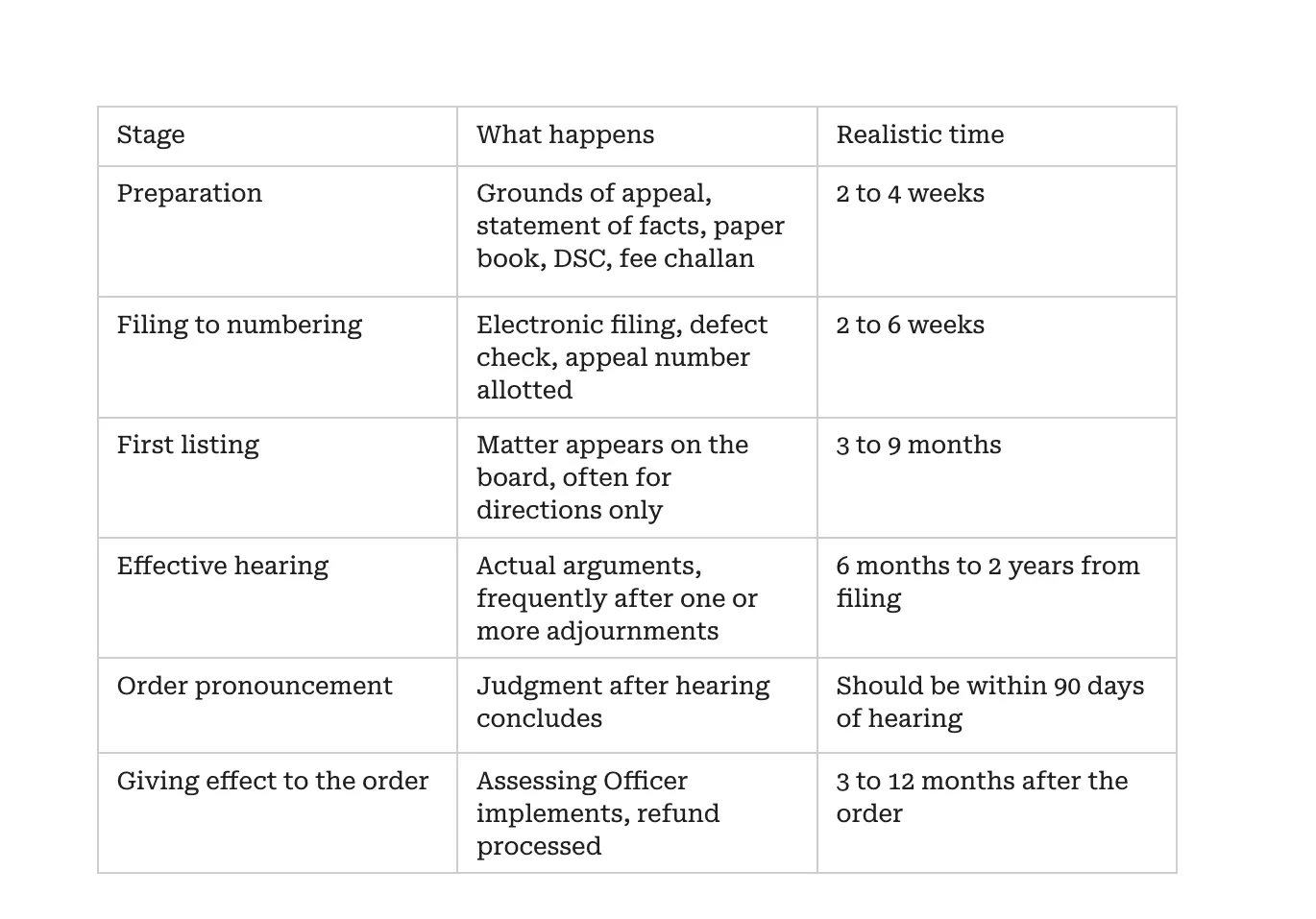
Total, realistically: 18 months to 4 years. Straightforward single-issue matters at a lighter bench move faster. Transfer pricing, search assessments and high-value additions at Mumbai or Delhi take longer.
The volume is simply enormous. Mumbai alone receives roughly 1,500 to 1,600 fresh appeals every month. Across the system, the Finance Minister noted in July 2026 that pendency at the first appellate level still stands at around 5.4 lakh appeals even after more than 34,000 were cleared, against a record 2.24 lakh disposals in FY26. She was blunt that this is not good enough.
The Tribunal is responding. Following the Vice Presidents' Conference in May 2026, appeals filed up to and including 2022 are now treated as old matters and given priority, adjournments in those matters are discouraged for both taxpayers and the Revenue, and some benches are dedicating a full working day each week to old cases.
There is also a real check on the worst delay of all, the reserved judgment that never arrives. In August 2026 the Bombay High Court, hearing from a taxpayer facing a fourth round of arguments in a matter heard three times without pronouncement, directed every ITAT bench in the country to strictly comply with the 90-day rule under Rule 34 of the ITAT Rules. If your matter is reserved and goes quiet, that direction is now your lever.
This is the cheap part, and it surprises people.
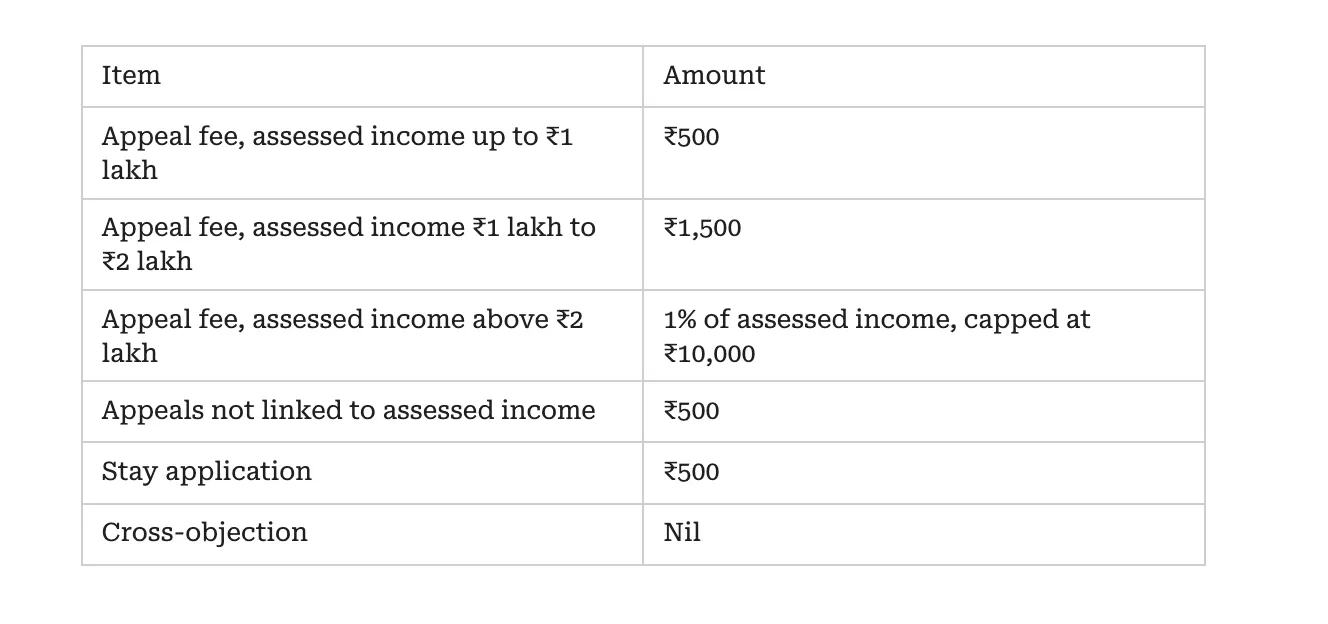
The Tribunal fee is capped at ₹10,000 no matter how large the demand. A ₹5 crore dispute and a ₹25 lakh dispute cost the same to file. Verify the current slab before you pay, and always attach the challan.
Professional fees. These vary widely by city, counsel and complexity, so treat any published figure as indicative only. A straightforward single-issue appeal handled end to end typically costs far less than most people fear. Complex matters involving transfer pricing, search assessments or multiple assessment years, especially where senior counsel appears, cost considerably more. Ask for a written scope covering drafting, paper book preparation and appearance, and ask specifically how adjournments are billed, because a matter that takes eight listings costs more than one that takes two.
The stay of demand. This is the big one and it is not a fee, it is cash out of your working capital. There is no statutory pre-deposit to file an income tax appeal, unlike GST. But if you want recovery of the demand held back while your appeal is pending, the working norm is paying 20% of the disputed demand and applying for stay, now under Section 340(6) of the new Act. In genuine hardship the Assessing Officer can grant stay on less, and a pending refund can be adjusted against it. On a ₹1 crore demand, that is ₹20 lakh sitting with the department for two to three years.
Interest. If you eventually lose, interest keeps accruing across the whole period the appeal was pending. If you win, your pre-deposit comes back with interest. Both directions belong in your calculation.
Time. Your finance team will spend real hours on paper books, reconciliations and hearing preparation across two to four years. That is a genuine cost, even though no invoice records it.
Also Read: Understanding and Resolving Inflated GST Tax Demands
Run these five checks honestly before you commit.
If the disputed amount is small, the point is genuinely arguable both ways, and the money is needed elsewhere, closing the demand is often the commercially correct decision. There is no medal for litigating.
Be ready at first listing. Paper book filed, case laws compiled, written submissions prepared. Do not seek adjournments, especially now that the Tribunal is actively discouraging them in old matters. If your case falls in the pre-2022 bucket, say so and ask for it to be taken up under the old-matters framework. Where a matter is reserved and no order arrives, invoke Rule 34 and the Bombay High Court's August 2026 direction. And keep track of your case status, which is now searchable online across all thirty ITAT bench locations.
DSRV and Co LLP advises clients on whether an appeal is worth filing before a rupee is spent, drafts grounds and paper books that hold up at hearing, handles stay applications and hardship representations, and appears before the CIT(A) and the ITAT. As one of the established chartered accountant firms in Gurgaon, we have spent more than 30 years on this work.
We will also tell you plainly when the numbers do not justify an appeal. That advice has saved our clients more money than most wins.
Must Read: How to Handle GST Litigation in India
Realistic timelines, filing fees, stay of demand, documents needed, and what happens after the Tribunal passes its order.
Realistically 18 months to 4 years from filing to order, depending heavily on the bench and complexity. Add another 3 to 12 months for the Assessing Officer to give effect to the order.
It is slab based, from ₹500 up to a maximum of ₹10,000 where assessed income exceeds ₹2 lakh, calculated at 1% of assessed income. A stay application costs ₹500.
No. There is no statutory pre-deposit for an income tax appeal. The 20% relates to obtaining a stay of recovery while the appeal is pending, and it can be reduced in hardship cases or adjusted against a pending refund.
Somewhat. Be ready at first listing, avoid adjournments, flag your matter if it was filed in 2022 or earlier, and rely on Rule 34 if a reserved order is delayed beyond 90 days.
Yes. The High Court hears only substantial questions of law. Build your full factual record at the Tribunal.
Form 115 under Section 362 of the Income-tax Act, 2025. Form 36 no longer applies. Filing is electronic with a DSC.
Before you spend three years on an appeal, spend fifteen minutes finding out if it is worth it. Send us the CIT(A) order and the demand. We will give you an honest read on your odds, a realistic timeline for your bench, and a full cost picture including the stay implications.

What triggers a transfer pricing dispute in India, the four stages it passes through, and where to go next depending on the stage you are at right now.

How NRIs are taxed in India: residential status, the 120-day rule, what income is taxable, DTAA relief, NRE and NRO accounts, property sales and return filing.
Which professionals can advise on a GST demand order in DRC-07 and file the appeal, what the pre-deposit requires, and how to choose before the clock runs out.
