

TDS on Software Payments to a Foreign Company: What Engineering Analysis Settled, and the Eight Situations Where You Must Still Deduct
Learn when TDS applies to software payments made to foreign companies, including eight situations where tax deduction remains mandatory.
Your company is about to remit USD 400,000 to a software vendor in Ireland. Finance has raised the invoice for approval. Somebody asks whether tax has to be deducted under section 195.
The instinctive answer, since March 2021, has been no. The Supreme Court in Engineering Analysis Centre of Excellence Pvt. Ltd. v. CIT settled that payments for the use of computer software are not royalty. On 11 May 2026 the Revenue’s review petitions against that judgment were finally dismissed, and the issue has attained finality after more than two decades of litigation.
The instinctive answer is also wrong about a third of the time. Engineering Analysis decided a narrow question on a specific set of facts. It did not hold that software payments are never taxable, and it left several categories entirely untouched. Assessing Officers have spent five years probing those gaps, and the reported cases show exactly where the withholding obligation survives.
This case study sets out what the Supreme Court actually decided, what it did not, and the eight fact patterns in which an Indian payer must still deduct tax.
Part 1 — The dispute that took twenty years
The competing positions
When an Indian company pays a foreign supplier for software, one of two characterisations must be right.
The Revenue’s case was that software is protected by copyright, that a licence to use software is a licence in respect of that copyright, and that consideration for the use of a copyright is royalty. Royalty paid by an Indian resident is income deemed to accrue in India under section 9(1)(vi), so the payer must deduct tax under section 195, and if it does not, the expenditure is disallowed under section 40(a)(i) and the payer is an assessee in default under section 201.
The taxpayers’ case was that buying a copy of software is no different from buying a book. The purchaser of a book acquires a copyrighted article. He does not acquire the copyright, and he cannot reproduce the book, publish it or make derivative works. What the end-user licence agreement gives him is the right to use one copy of a copyrighted article, subject to restrictions. That is a sale of goods, and the consideration is business profit, taxable in India only if the vendor has a permanent establishment here.
The four categories before the Court
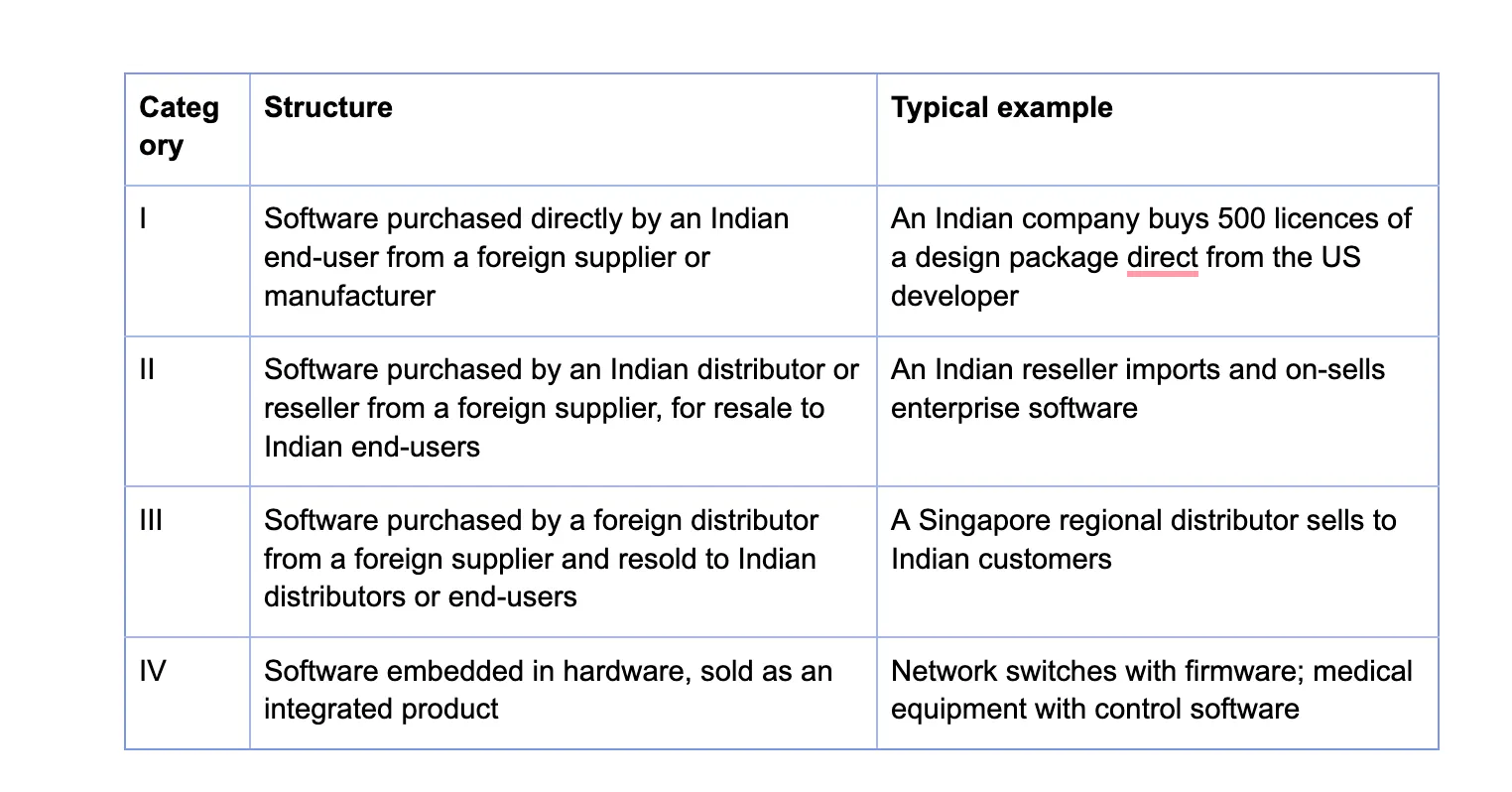
The Supreme Court heard a batch of 86 appeals and grouped the transactions into four categories, which remain the correct starting point for analysing any software payment.
Part 2 — What the Supreme Court held
The judgment, reported at (2021) 432 ITR 471, decided all four categories in favour of the taxpayer. Its reasoning rests on five propositions, and it is worth being precise about them because each one carries a limitation.
Proposition 1: A licence to use is not a licence in the copyright
The Court examined the end-user licence agreements and held that a licence permitting an end-user to use software, subject to restrictions on copying, modification and reverse engineering, is not a licence of the kind contemplated by section 30 of the Copyright Act, 1957. The EULA imposes restrictive conditions on the user; it does not part with any interest in the rights enumerated in sections 14(a) and 14(b) of the Copyright Act — the rights to reproduce, issue copies, make adaptations, and so on.
The distinction is between the copyright and the copyrighted article. Buying a copy conveys the article. Royalty arises only where the payment is for the right to exploit the copyright itself.
Proposition 2: The treaty definition governs, and it is narrower
Article 12 of India’s treaties defines royalty, in the relevant limb, as payment for the use of, or the right to use, any copyright of a literary, artistic or scientific work. Because the payment is not for the use of the copyright, it falls outside the treaty definition, and no royalty arises under the treaty.
Proposition 3: The treaty prevails over the wider domestic definition
Section 90(2) permits a non-resident to be governed by the treaty where it is more beneficial. The domestic definition of royalty in section 9(1)(vi) is wider than the treaty definition — particularly after Explanation 4 was inserted by the Finance Act, 2012 to cover the transfer of all or any rights in respect of any right, property or information including the use of computer software. The Court held that a wider domestic definition cannot be read into the treaty. Where the treaty applies and is more beneficial, it governs.
Proposition 4: Explanation 4 cannot operate retrospectively against a payer
Explanation 4, though stated to be retrospective from 1 June 1976, could not impose a withholding obligation on a payer for years before its insertion in 2012. A person cannot be required to deduct tax by reference to a law that did not exist when he made the payment. The Court applied the principle in Ishikawajima-Harima Heavy Industries and the impossibility-of-performance reasoning.
Proposition 5: Section 195 is triggered only by chargeability
Following GE India Technology Centre Pvt. Ltd. v. CIT (2010) 327 ITR 456, the Court reaffirmed that the obligation under section 195 arises only where the sum paid is chargeable to tax in India. Section 195 is not a free-standing collection mechanism attaching to every foreign remittance. If the receipt is not chargeable, there is nothing to deduct.
The consequence for the two Karnataka decisions
The judgment overruled the Karnataka High Court in CIT v. Samsung Electronics Co. Ltd. and CIT v. Synopsis International Old Ltd., which had held the opposite. Assessment orders framed on the strength of those decisions — and there are still some in the appellate pipeline — have lost their foundation. The Tribunal has been setting them aside on that ground alone, most recently in a Bangalore Bench decision of June 2026 in a Revenue appeal concerning a US software company.
Part 3 — The review dismissal of 11 May 2026
For five years the Revenue took the position, in assessment and before the Tribunal, that Engineering Analysis should not be applied because a review petition was pending. That argument is now spent.
- An earlier set of review petitions was dismissed on 23 April 2024, on the ground of an unexplained delay of 515 days and also on merits.
- Review Petitions (C) Nos. 1422—1497 of 2021 were dismissed on 11 May 2026 by a three-Judge Bench comprising Justices Sanjay Kumar, K. V. Viswanathan and K. Vinod Chandran, which noted the earlier dismissal by a coordinate Bench and declined to reopen the settled issue.
The Supreme Court had in any event held, while dismissing a special leave petition in 2023, that Engineering Analysis was holding the field and had to be followed. With the review now finally dismissed, an assessment or appeal that proceeds on the footing that the judgment is under challenge is untenable, and this should be taken as a preliminary point wherever the Revenue still runs it.
Part 4 — What Engineering Analysis did not decide
This is the part that matters commercially, and it is where the reported decisions of the last five years have concentrated.
The judgment answered one question: whether consideration for the use of computer software, under EULAs and distribution agreements of the kind before the Court, is royalty under Article 12 of the applicable treaties. It did not answer, and did not purport to answer, any of the following:
- Payments to residents of countries with which India has no treaty. The entire reasoning rests on section 90(2) and the treaty definition. Where there is no treaty, there is nothing to prevail over the domestic definition, and Explanation 4 to section 9(1)(vi) applies on its terms.
- Payments that genuinely transfer copyright rights. The Court was explicit that royalty arises where the copyright is parted with. Where a contract confers the right to reproduce, to sublicense commercially, to make derivative works or to access and modify source code, the payment is royalty.
- Payments to residents. The judgment concerns section 195. It says nothing about a payment by one Indian resident to another, which is governed by section 194J.
- The service element in a bundled contract. Where a contract combines a licence with implementation, customisation, training or support, the service element must be characterised separately as fees for technical services or fees for included services.
- Equipment royalty and the "process" limb. Article 12 in most treaties also covers the use of, or right to use, industrial, commercial or scientific equipment, and in some treaties, a secret process. These limbs were not in issue.
- Whether the treaty is available at all. Treaty benefit is not automatic. It depends on the recipient establishing residence and, in many cases, satisfying a limitation-of-benefits article and furnishing prescribed documentation.
Part 5 — The eight situations where you must still deduct
Each of the following is grounded in the post-2021 case law or in the express limits of the judgment itself.
1. The vendor is resident in a non-treaty jurisdiction
Engineering Analysis is a treaty case. Its ratio has no application where the recipient is resident in a country with which India has no double taxation avoidance agreement. The domestic definition of royalty then governs, Explanation 4 to section 9(1)(vi) covers the use of computer software in terms, and the payment is chargeable.
This is not academic. Software and digital services are increasingly sourced from jurisdictions outside India’s treaty network, and the position must be checked against the current treaty list rather than assumed. Where there is no treaty, withholding is at the domestic rate.
2. The contract transfers rights in the copyright
The controlling question is what the agreement gives away, not what the product is. Withholding is due where the contract confers any of the following:
- the right to reproduce the software and issue copies to the public;
- the right to sublicense or commercially exploit it, as distinct from the right to resell shrink-wrapped copies;
- the right to make adaptations, derivative works or modifications; or
- access to, and the right to use, the source code.
The Revenue frequently argues that a confidentiality clause in a distribution agreement implies access to source code and therefore a transfer of copyright. That argument has been rejected: the Bangalore Bench, in a June 2025 decision concerning an Irish networking company, held that a confidentiality clause is there to protect the vendor’s proprietary rights and confers no copyright interest on the distributor. Read the clause; do not accept the label.
3. Payment to a resident — section 194J still applies
Where an Indian company buys software from an Indian reseller, section 195 is not in play at all and Engineering Analysis is irrelevant. Section 194J applies to a payment in the nature of royalty to a resident, at 10 per cent.
The relief here is not the Supreme Court judgment but CBDT Notification No. 21/2012, which exempts a second-level or subsequent transfer of software from withholding, subject to conditions: the software must be acquired in a subsequent transfer without modification, tax must have been deducted at the earlier level, and the transferee must obtain a declaration from the transferor. Those conditions are frequently not satisfied in practice because nobody collects the declaration. Collect it.
4. The contract bundles services with the licence
An enterprise software contract is rarely a pure licence. It typically includes implementation, configuration, data migration, user training, and annual maintenance and support.
The licence component follows Engineering Analysis. The service component does not. It must be tested against the fees for technical services article of the treaty, and in the case of the India-United States and India-United Kingdom treaties, against the narrower "fees for included services" definition with its make-available requirement — technical knowledge, experience or skill must be made available to the recipient such that he can apply it independently.
Routine annual maintenance, bug fixes and helpdesk support generally do not make anything available and are not taxable. Bespoke customisation, architecture design and knowledge transfer frequently do. Where an invoice is a single consolidated figure, the Assessing Officer will characterise the whole of it on the least favourable footing available to him. The remedy is to price and invoice the components separately in the contract itself.
5. The Revenue characterises the payment as equipment royalty
For cloud and hosting arrangements the Revenue’s argument has shifted away from software royalty and toward equipment royalty — that the customer is paying for the use of, or right to use, industrial, commercial or scientific equipment within Explanation 2(iv) to section 9(1)(vi) and the corresponding treaty limb.
That argument has largely failed. The Delhi High Court, in the Revenue’s appeal concerning payments by an Indian e-commerce company to Amazon Web Services for cloud computing, held that the payments were neither royalty nor fees for included services under the India-United States treaty. The reasoning turned on possession and control: AWS retained exclusive control of its infrastructure throughout, and the customer merely accessed resources over the internet through an automated self-service platform without acquiring possession or control of any equipment. Without possession or control there is no "use of, or right to use" equipment.
The same reasoning has produced consistent outcomes for SaaS. In a 2026 decision the Delhi Bench held that subscription receipts of a US product-analytics company from Indian customers were neither royalty nor fees for included services under the India-United States treaty, rejecting the Assessing Officer’s contentions of dedicated server infrastructure and human intervention.
But note the shape of the test. Possession and control are the operative facts. A hosting arrangement that gives the Indian customer a dedicated, identified server which it controls and configures is materially different from a multi-tenant self-service platform, and the outcome may differ.
6. The recipient cannot establish treaty entitlement
This is where most withholding failures actually occur, and it has nothing to do with characterisation.
Engineering Analysis works through section 90(2). If the recipient cannot establish that it is entitled to the treaty, section 90(2) does not engage and the domestic definition applies. Treaty entitlement requires, at minimum:
- a valid tax residency certificate from the treaty country for the relevant period;
- the prescribed additional particulars, historically furnished in Form 10F and filed electronically — the form and its number should be confirmed against the Income-tax Rules, 2026 for remittances on or after 1 April 2026;
- a no-permanent-establishment declaration; and
- satisfaction of the limitation-of-benefits article where the treaty contains one, notably the India-Singapore and India-United States treaties.
A separate and commonly missed trap is section 206AA. Where the recipient does not furnish a PAN, tax must be deducted at the higher of the applicable rate or 20 per cent, notwithstanding the treaty. Relief is available under Rule 37BC where the non-resident furnishes name, e-mail, contact details, address, tax residency certificate and tax identification number. Collect these before the first remittance, not at year-end.
7. The payment is for content or data rather than software
Subscriptions to databases, market data feeds, research libraries and similar services are not software payments at all, and Engineering Analysis is not directly in point. Characterisation turns on whether the payment is for the use of a copyright in the underlying content, for information concerning industrial, commercial or scientific experience, or simply for access to a compiled service.
The weight of authority holds that a subscription conferring only the right to view or search a database, without any right to exploit the content commercially, is not royalty. But the analysis is separate and must be run separately — particularly where the subscription includes a right to redistribute extracts to clients, which is a different matter.
8. The vendor is related, and transfer pricing applies alongside
Where the software is licensed by a group company, the characterisation question is only half the analysis. The payment is an international transaction between associated enterprises and must satisfy the arm’s length standard, with contemporaneous documentation. A payment correctly characterised as business profits and correctly not subjected to withholding can still be disallowed in part on transfer pricing grounds. The two workstreams must be run together, not sequentially.
Part 6 — An illustrative walk-through
The following composite scenario is illustrative and does not describe any particular client engagement. It is constructed to show how the eight tests operate together on a single contract.
An Indian manufacturing group enters into a three-year master agreement with a software vendor incorporated and tax resident in the Netherlands. The agreement covers four elements, invoiced as a single annual fee of USD 1.2 million.
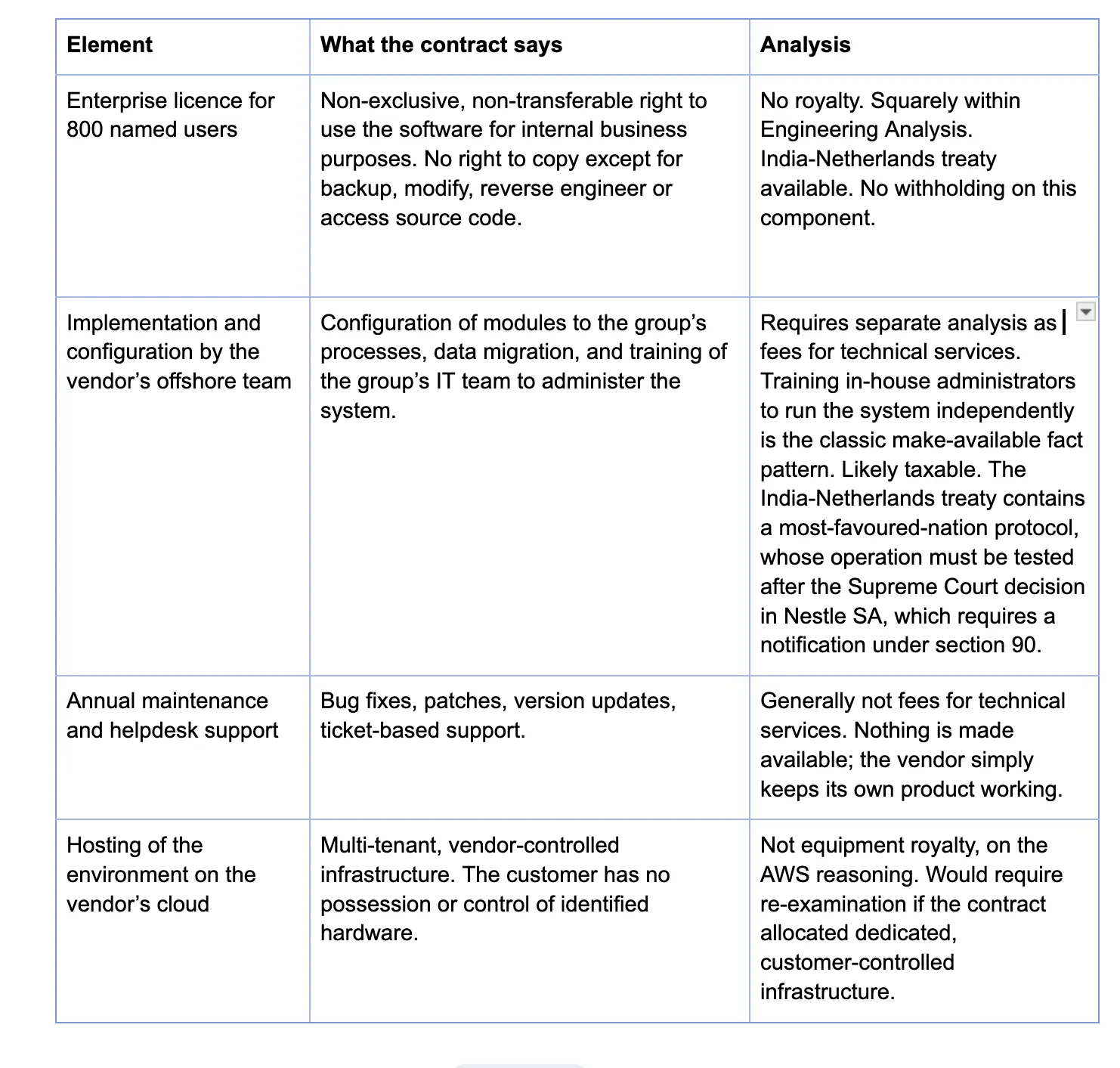
Three practical conclusions follow, and they are the conclusions that matter more than the legal analysis.
First, the single consolidated invoice is the problem.
On these facts one component is probably taxable and three are not. If the vendor invoices USD 1.2 million as one line, the Assessing Officer will have every incentive to characterise the whole sum unfavourably, and the burden of apportionment will fall on the payer at assessment, years later, without contemporaneous evidence. The apportionment must be built into the contract and the invoicing at the outset.
Second, the treaty documentation must precede the first remittance.
A tax residency certificate obtained in year three does not cure a year-one default.
Third, where the position is genuinely mixed, use section 195(2).
An application to the Assessing Officer for a certificate determining the appropriate proportion chargeable to tax converts an uncertain exposure into a determined one, and protects the payer against the disallowance and default consequences described below. It is underused, largely because it takes time that nobody budgets for.
Part 7 — What it costs to get wrong
The exposure sits with the payer, not the vendor, and it is not confined to the tax.
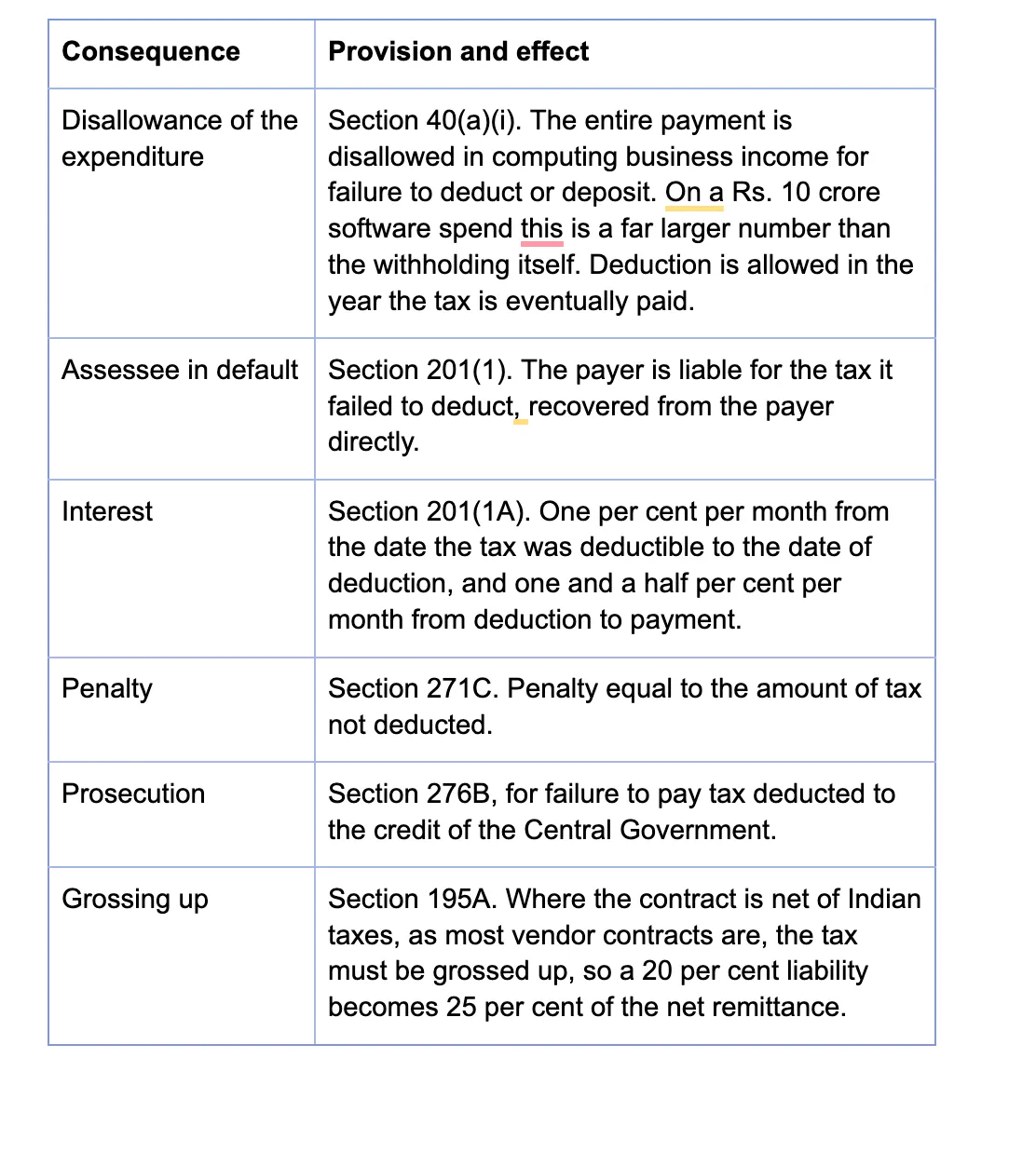
The rate matters too. Where royalty or fees for technical services is chargeable and the treaty does not apply, section 115A prescribes a base rate of 20 per cent, raised from 10 per cent by the Finance Act, 2023 with effect from assessment year 2024-25, plus surcharge and cess. The commercial gap between a correct and an incorrect characterisation is therefore substantial.
Part 8 — The Income-tax Act, 2025: what changed on 1 April 2026
The Income-tax Act, 2025 came into force on 1 April 2026 and renumbered the entire statute. The substantive law on software characterisation is unchanged, and Engineering Analysis continues to govern, but every provision cited in an assessment order or an appeal now has two numbers depending on the year involved.
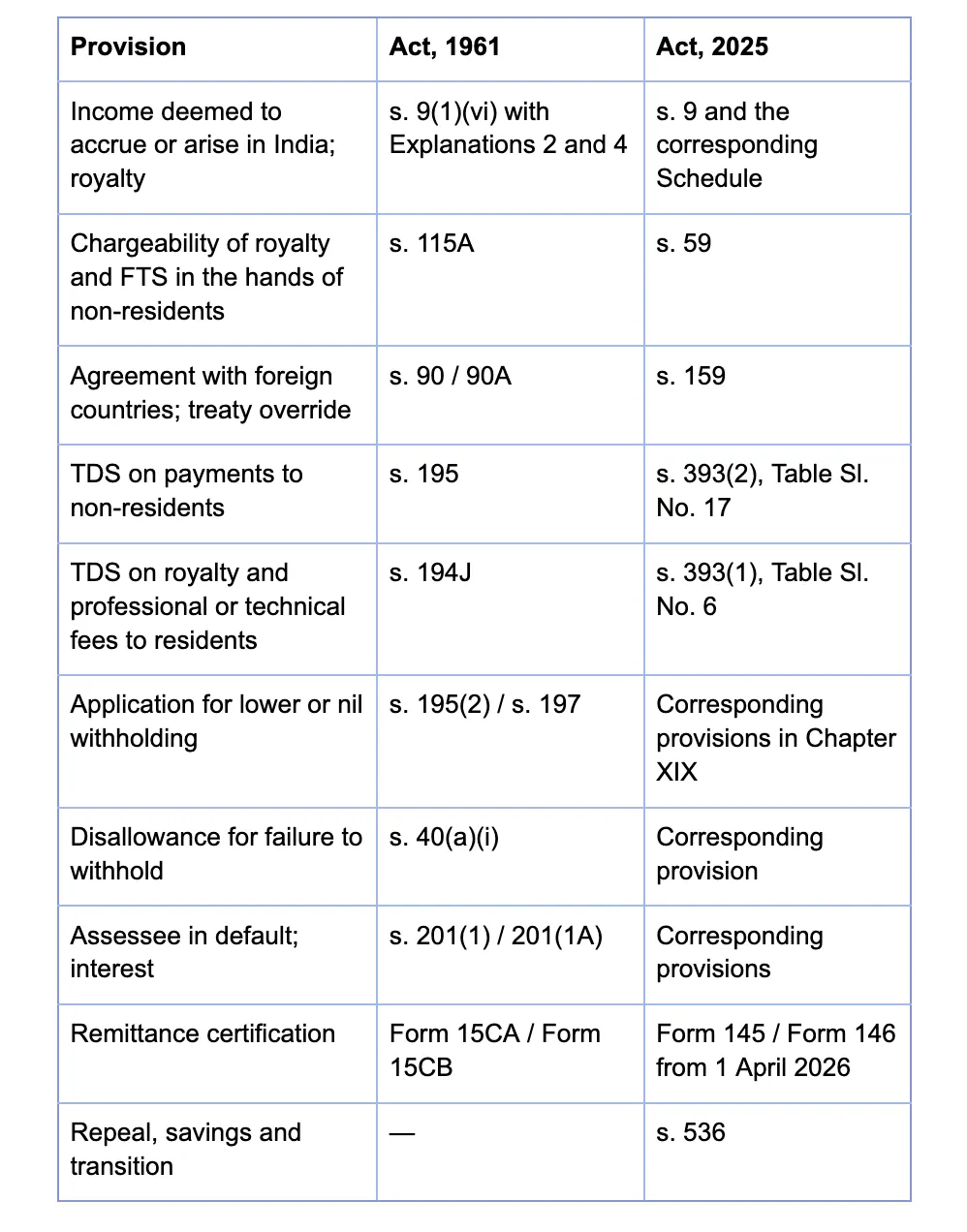
Two practical points. Numeric TDS payment codes have replaced the alphanumeric section codes in challans and returns, so the classification must be right at the point of payment rather than corrected later. And for any period straddling 1 April 2026, the transition provision determines which Act governs the proceeding, and that should be checked rather than assumed.
Part 9 — The decision framework
Run every cross-border software payment through these seven questions, in this order, and record the answers on the file before the remittance is made.
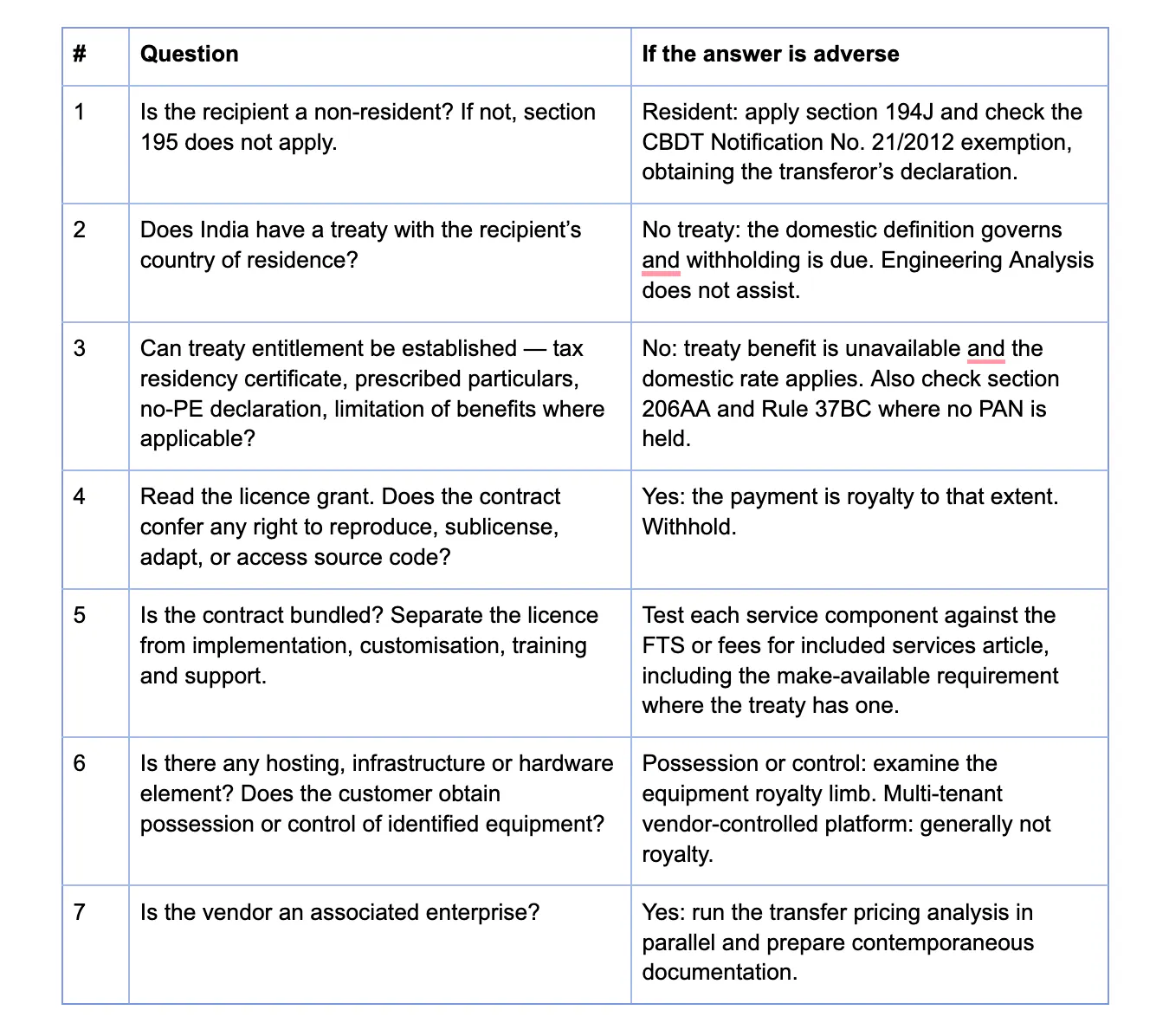
Where questions 4, 5 or 6 produce a mixed answer and the sum is material, consider an application under section 195(2) rather than taking a unilateral position.
Part 10 — Documentation to hold on file
Characterisation disputes are decided on contracts, and they are decided several years after the remittance. The file must be built at the time.
- The master agreement, the end-user licence agreement and every schedule, statement of work and order form. The licence grant clause and the restrictions clause are the two provisions the Tribunal will read first.
- The invoice, with the components separately priced. A single consolidated line is the most common cause of an adverse characterisation.
- The tax residency certificate for each relevant period, the prescribed particulars in the applicable form, and the no-permanent-establishment declaration.
- The recipient’s PAN, or the Rule 37BC particulars if no PAN is held.
- Form 145 and Form 146 for the remittance, for payments on or after 1 April 2026.
- A contemporaneous internal note recording the characterisation adopted and the reasons for it, signed off before the remittance. Where a position is later challenged, a reasoned note made at the time is materially more persuasive than the same reasoning reconstructed at assessment.
- Where the vendor is a group company, the transfer pricing documentation and benchmarking.
Part 11 — Where the law now stands
Engineering Analysis is final. The review petitions were dismissed on 11 May 2026, and the Supreme Court has confirmed on more than one occasion that the judgment holds the field and must be followed. The stream of favourable Tribunal and High Court decisions since 2021 — across standardised licences, embedded software, distributor arrangements, cloud infrastructure and SaaS subscriptions — has been consistent, and the Karnataka High Court decisions on which the Revenue built its case have been overruled.
It would be a mistake to read that as meaning no software payment is ever taxable. What the judgment settled is a characterisation principle, not a blanket exemption, and the principle has clear edges. The payments that remain chargeable are those where a treaty is unavailable or cannot be established, where the contract genuinely parts with copyright, where services are bundled with the licence, or where the arrangement is one of infrastructure rather than software.
The practical consequence for a finance team is that the analysis has become a contract-reading exercise rather than a legal one. Almost every case now turns on what the licence grant says, how the invoice is drawn, and whether the treaty documentation was collected before the money moved.
Frequently asked questions
Is TDS applicable on software purchased from a foreign company?
Generally no, where the payment is for the use of standardised software under a licence that does not transfer any copyright, and the vendor is resident in a country with which India has a tax treaty and can establish entitlement to it. The Supreme Court so held in Engineering Analysis Centre of Excellence Pvt. Ltd. v. CIT (2021) 432 ITR 471, and the Revenue’s review petitions were dismissed on 11 May 2026. Withholding survives where there is no treaty, where copyright rights are transferred, or where services are bundled with the licence.
What did the Engineering Analysis case decide?
That payments by Indian end-users and distributors to non-resident software suppliers, for the resale or use of computer software under end-user licence agreements and distribution agreements, are not royalty under Article 12 of the applicable tax treaties. What is acquired is a copyrighted article, not the copyright. Consequently there is no obligation to deduct tax under section 195.
Do I have to deduct TDS on a SaaS subscription paid to a US company?
On the current state of authority, generally no. The Delhi High Court has held that cloud computing payments to Amazon Web Services were neither royalty nor fees for included services under the India-United States treaty, because the provider retained control of its infrastructure and the customer obtained no possession or control of equipment. Tribunal decisions on SaaS subscriptions have followed the same reasoning. Treaty documentation must still be in place, and any bundled implementation or customisation services must be characterised separately.
Does Engineering Analysis apply if there is no tax treaty with the vendor’s country?
No. The judgment operates through section 90(2) and the narrower treaty definition of royalty. Where there is no treaty, the domestic definition in section 9(1)(vi) read with Explanation 4 governs, that definition expressly covers the use of computer software, and withholding is required.
Is TDS deductible on software bought from an Indian reseller?
Section 195 does not apply to a payment to a resident. Section 194J applies to a payment in the nature of royalty to a resident. Relief is available under CBDT Notification No. 21/2012 for a second-level or subsequent transfer of software without modification, subject to conditions including a declaration from the transferor that tax was deducted at the earlier level.
What happens if I do not deduct tax and the department later says I should have?
The expenditure is disallowed under section 40(a)(i), the payer becomes an assessee in default under section 201(1) and is liable for the tax itself, interest runs under section 201(1A), and penalty equal to the tax may be levied under section 271C. Where the contract is net of Indian taxes, the liability must also be grossed up under section 195A.
Which section covers TDS on foreign payments under the Income-tax Act, 2025?
Section 195 of the 1961 Act is now Section 393(2), Table Serial Number 17, of the Income-tax Act, 2025, with effect from 1 April 2026. The substantive law on characterisation is unchanged.
Disclaimer: This case study is published for general information and business awareness. It is a composite drawn from matters handled by the firm, with identifying details changed to protect client confidentiality; the narrative is illustrative of the legal framework and our approach. It does not constitute professional or legal advice, and outcomes depend on the facts of each matter. Statutory provisions and judicial precedents should be verified as on the date of use. For advice on a specific notice or proceeding, please contact DSRV & Co. LLP.
