

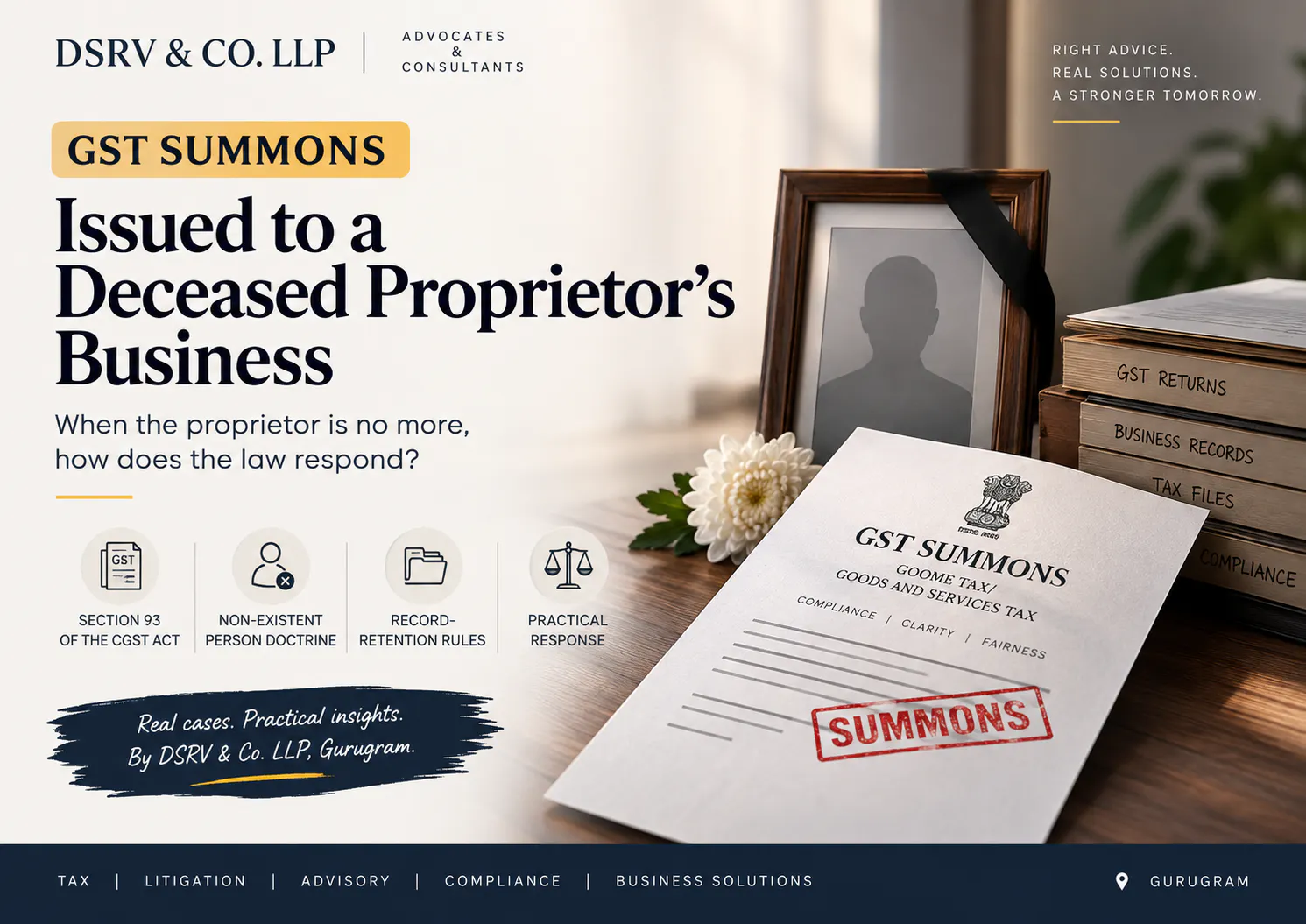
GST Summons Issued to a Deceased Proprietor's Business — How We Protected the Legal Heir
A GST summons arrived for a proprietorship whose owner had passed away and whose business had closed years earlier. How Section 93 of the CGST Act, the non-existent person doctrine and record-retention rules shaped the response. By DSRV & Co. LLP, Gurugram.
Few communications are more distressing for a family than a tax summons addressed to a loved one who is no longer alive. Yet with GST enforcement now driven by data analytics reaching back to the earliest years of the regime, notices and summons to closed businesses — and to proprietors who have since passed away — arrive with surprising regularity. This case study, drawn from a recent matter handled by our GST litigation team (with identifying details changed to protect client confidentiality), explains what the law actually says, and how a legal heir should respond.
The situation: a summons for a business that no longer existed
Our client's family ran a small trading proprietorship in Haryana. The business had been closed since late 2018 — no sales, no purchases, no activity of any kind. The GST registration was cancelled in early 2021. The proprietor — the sole owner and the only person who ever ran the business — passed away in mid-2025.
More than a year after his demise, the family received a summons under Section 70 of the CGST Act from the anti-evasion wing, addressed to the proprietorship concern, requiring personal appearance within a week, production of all sale and purchase records — ledgers, invoices, bank statements, e-way bills — and the tendering of a statement. The stated subject of the inquiry: simply ‘GST matter’. The family member who received it had never worked in the business, had no idea where records of a concern closed seven years earlier might be, and — understandably — was alarmed by the warning that non-compliance is a punishable offence.
The legal reality: a proprietorship dies with its proprietor
The first and most important legal principle is one many taxpayers — and, occasionally, field formations — overlook: a sole proprietorship has no legal existence separate from its proprietor. The trade name is only a business style; the ‘person’ in law is the individual. When the proprietor passes away, the entity named in the summons ceases to exist. The Supreme Court has held, in the context of proceedings against amalgamated companies, that proceedings initiated against a non-existent person are void from the beginning — not a clerical slip that can be cured — and High Courts have applied the same principle to GST notices issued to deceased persons.
The second principle is Section 93 of the CGST Act — the only provision through which the tax department can lawfully proceed where a proprietor has died. It permits recovery from a legal representative, but only to the extent of the estate the heir has received, and only after a determination made against the legal representative in that capacity, with notice and hearing. The Bombay High Court reaffirmed in 2026 that action against a legal heir without a prior Section 93 determination is a jurisdictional error — quashing a bank account attachment made against an heir. A summons addressed to the deceased's erstwhile concern, without any Section 93 process, puts the cart before a horse that does not exist.
A third, practical layer completes the picture: Section 36 of the CGST Act requires business records to be retained for seventy-two months from the annual return due date. For the earliest GST years, that period has already expired. An heir who never participated in the business cannot be faulted for not producing records the law no longer required even the taxpayer to keep.
Our approach: assert the law, offer complete cooperation
The instinctive reactions — ignoring the summons because ‘the person is no more’, or panicking and appearing without preparation — are both wrong. A summons inquiry is a judicial proceeding, and anti-evasion inquiries into closed businesses usually mean the concern's GSTIN has surfaced in someone else's investigation, typically an input tax credit chain. The response we prepared therefore did three things at once:
It placed the foundational facts on record with evidence — the death certificate, the closure of business, and the registration cancellation — so that no future proceeding could claim ignorance of them.
It asserted the legal framework without hostility — the non-existent person principle, the exclusivity of Section 93, and the record-retention position — expressly ‘without prejudice’ and alongside an unqualified assurance of cooperation, including a bona fide search for records and requisitioning of old bank statements.
It made practical, reasonable requests — discharge of the summons issued to a non-existent entity; exemption from personal appearance with representation through an authorised representative (an alternative the summons itself contemplates); disclosure of the actual subject-matter of the inquiry, which CBIC's own instructions require the officer to indicate where practicable; and reasonable time to trace whatever might still exist.
This combination matters. The legal objections protect the family's rights and the estate; the cooperative posture protects them from any suggestion of obstruction — and in our experience, it is the combination that persuades investigating officers to route the inquiry correctly rather than escalate it.
The takeaway for families and heirs
If a GST notice or summons arrives for a deceased person's business: do not ignore it, and do not appear unprepared. Respond in writing before the returnable date; enclose the death certificate and cancellation records; state clearly that you were not part of the business and do not hold its records; invoke Section 93 as the only lawful route while offering cooperation; and take professional advice immediately — the response you file first will shape every proceeding that follows. Liability, if any is ever established, is limited to the estate inherited — an heir's personal assets are not exposed.
Frequently asked questions
Can the GST department issue a notice or summons in the name of a deceased person?
No. A notice or summons addressed to a deceased individual — or to his sole proprietorship, which has no separate legal existence — is directed to a non-existent person and is void. The department's lawful route is to proceed against the legal representative under Section 93, after notice to the heir in that capacity.
Is a legal heir personally liable for the GST dues of a deceased parent or spouse?
An heir's liability, where the business is discontinued, is limited to the extent of the estate inherited from the deceased. Personal assets of the heir are not exposed. Even that limited liability must first be determined through a proceeding in which the heir is given notice and a hearing.
Do heirs have to produce business records of a concern closed years ago?
Records must be retained for seventy-two months from the annual return due date under Section 36. Once that period expires, there is no obligation to hold records; and an heir who never participated in the business cannot be presumed to possess them. A bona fide, documented effort to trace what exists — including bank statements from the bank — is the right response.
Should the family simply ignore a summons since the addressee has died?
No. Ignoring a summons invites avoidable complications, including allegations of non-compliance and follow-up action. The correct course is a written response before the returnable date, placing the death and closure on record, asserting the legal position, and offering cooperation through an authorised representative.
How DSRV & Co. LLP can help: our GST litigation team regularly represents families, legal heirs and successors in notices, summons and demand proceedings involving deceased proprietors, closed businesses and cancelled registrations — from the first response through adjudication, appeal and writ. If your family has received such a notice, contact us before the returnable date: the first written response is the one that matters most.
Disclaimer: This case study is published for general information and business awareness. Identifying details have been changed to protect client confidentiality; the narrative is illustrative of the legal framework and our approach. It does not constitute professional or legal advice, and outcomes depend on the facts of each matter. Statutory provisions and judicial precedents should be verified as on the date of use. For advice on a specific notice or proceeding, please contact DSRV & Co. LLP.
